Registro dos eventos
Page under construction
Event registration
As preparation for this section, the teacher may discuss with students how GPS works, covering basic concepts of how location works (using geometry and satellite positions to "triangulate" the GPS device's position), the definition of the second (transition frequency in the cesium atom), atomic clocks and relativity (two clocks – one on board the satellite and one on the Earth's surface – measure different times due to the gravitational field).
As we saw in the coincidence section, the passage of cosmic rays through our detector can generate what we call an event. If we measure how many events per unit of time our detector identifies, we get the cosmic ray rate. This rate can vary for several reasons:
- atmospheric conditions
- detector orientation (see
angular distribution of cosmic rays) - geometry and material of the scintillators
- efficiency of light collection from the scintillators by the sensors
statistics
Let us discuss the last item on the list above, statistics. Even if it were possible to make muons with exactly the same energy always hit the detector at the same position and with the same direction, that does not mean that all muons would always be detected. This is because the interaction process with matter is a statistical process, meaning there is a probability that this muon will interact with the medium.
How many planes did the muon cross?
We can have (and in fact we do have) a clock to measure the instant when the muon crossed our detector. As we have seen, it is quite possible that instead of detecting a single muon, we detect several muons (and electrons) that are part of a particle shower. This shower is formed by many particles distributed in space that arrive at the detector at almost the same time (not exactly at the same time, but we will leave that discussion for later). With a single station, we can place the planes side by side and see if we get a coincidence between the events that cross all the detection planes.
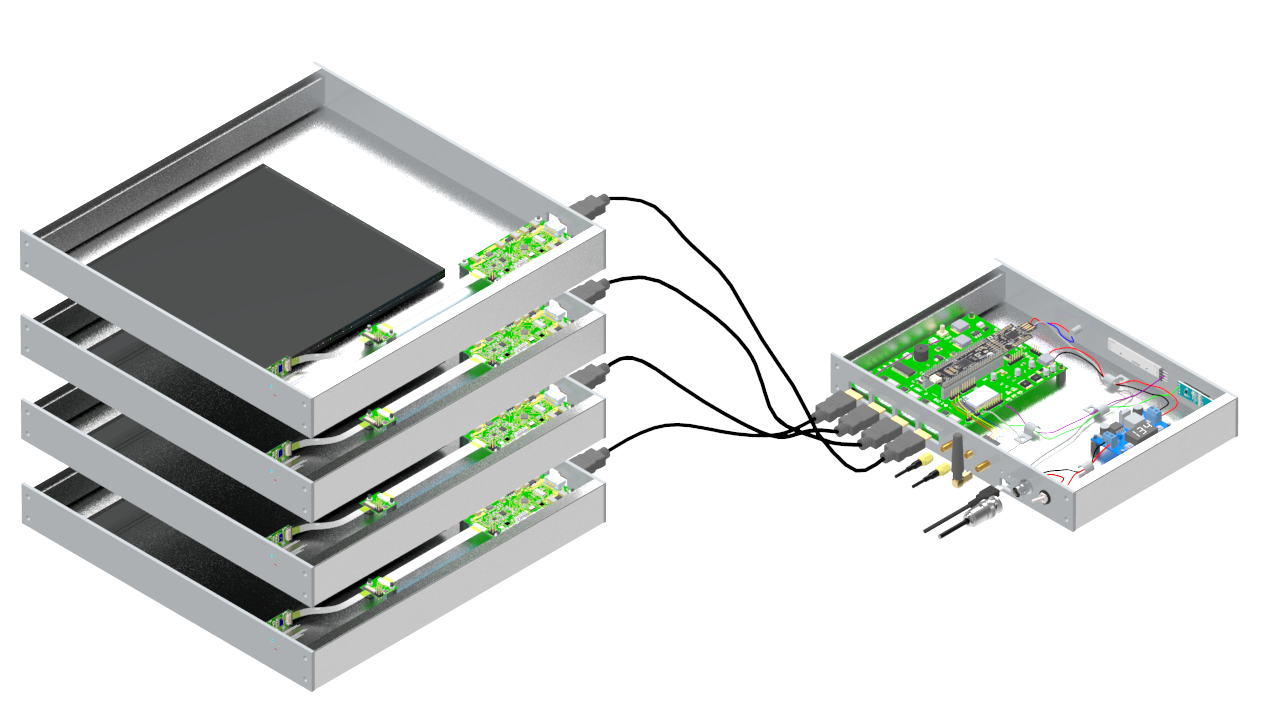
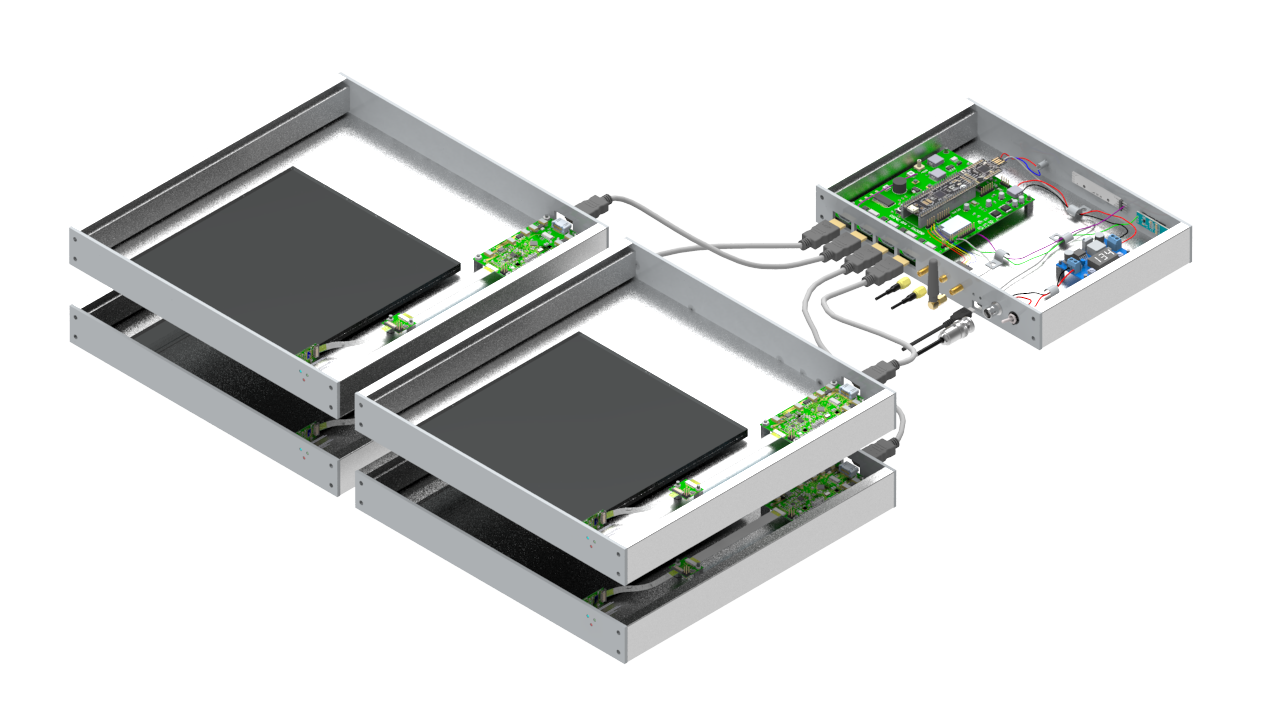
Image Credits: Cosmic Rays in Schools Project
This is easy with a single system: just program it to accept events on all 4 detection planes and simply change the configuration.
But suppose we are now interested in knowing whether we have a large shower – for example, by placing two detectors in two separate classrooms. These are two separate, independent devices that are measuring cosmic rays in the same way. How can we perform the coincidence between these two separate systems?
This is a good point to revisit the concept of coincidence and ask the students for their suggestions on how to synchronize two separate devices. This is a difficult question, so try to help them with some parallel example.
We could, for example, try to connect the two systems with a wire where one notifies the other that it has detected something. But what if we have 3 detectors? What if we have rooms in separate buildings? You can see that this solution quickly becomes impractical.
When did the muon pass?
But thanks to GPS, we can solve this system. As you may have seen, GPS works by correlating the position of several satellites in orbit (which is very well known) with the time at which the radio signal leaving the satellite is measured. As you have seen, it is not just a geometric problem; even the Earth's gravitational field has to be considered (time on the Earth's surface passes more slowly than on the satellite!). It is a very small difference, but since light travels at 300,000 km/s, this small difference must be taken into account.
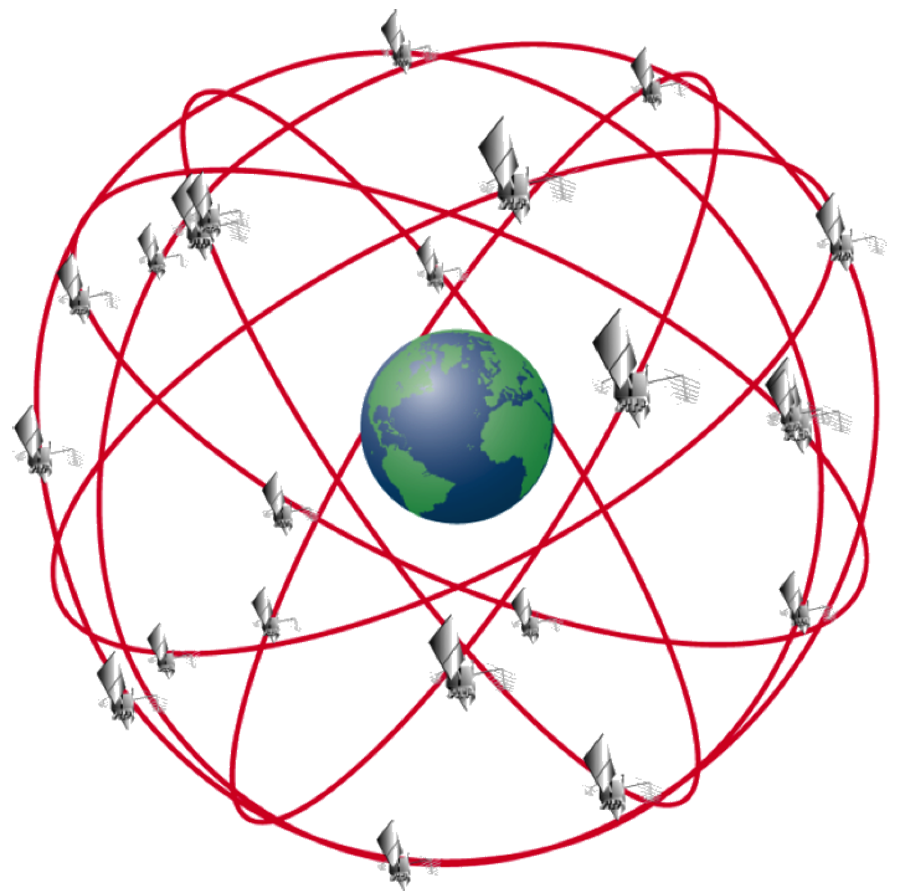
Image Credits: Stato Science
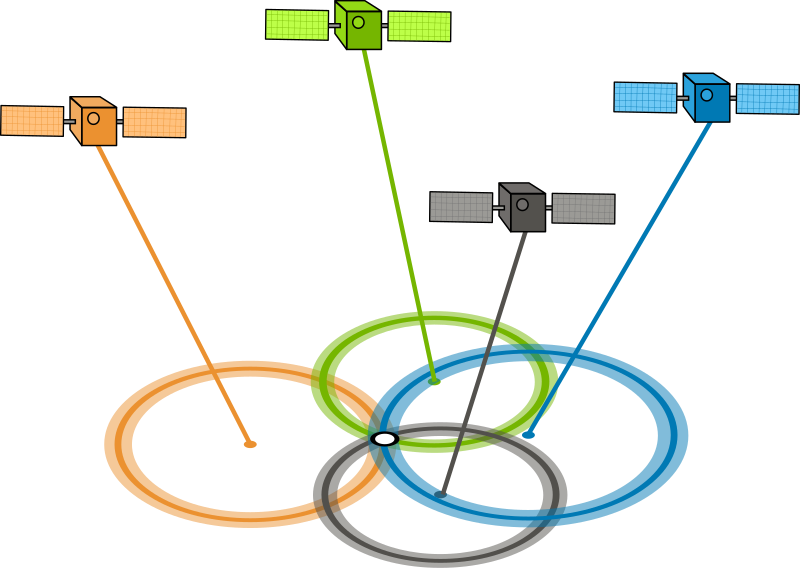
Image Credits: Gis Geography
But what matters to us here is that we have a clock on Earth (in your cell phone's GPS, for example) that is always synchronized with the satellite's clock, which is a much more precise clock than your GPS's and is also synchronized with reference time stations on Earth.
Meaning that we need very well-synchronized clocks to detect showers that truly came from the same original particle.
All cosmic ray measurement stations have a built-in GPS. This allows our clock to always be synchronized with the GPS system clock, even across different stations. We can maintain this synchronization with an uncertainty of approximately 30 ns between stations. Thus, if for each event we also record the time from our GPS clock, all stations will be marking the same time (within about 30 ns). There are even more precise GPS units, with about 2 ns accuracy. This allows two or more stations to register the event and, along with that event, the time measured by each station's clock. If we put this into a table, we can select events that were recorded by different stations within the same 30 ns interval! And this works for any number of stations, placed anywhere (as long as they have access to the GPS signal).
We thus move from an online coincidence (done by the electronics) to an offline coincidence (done by data analysis).
Our events are thus: a field indicating which detector planes were triggered by the passage of a cosmic ray and the exact instant at which this occurred.
Explain how events are placed into the table; information flow? This might be unnecessary because the data format is JSON (which is quite explicit...)
- add a simplified Grafana panel with the event sump
- add a Grafana panel with the GPS dump